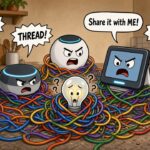








Matter and Thread were supposed to make the smart home simple. Buy a device with the logo, set it up once, and use it with whatever assistant you want. That was the pitch.
That is not what happens. Once something is set up in Alexa or SmartThings, Apple Home and Google can’t see it. Not unless you share it. And sharing it barely works, if it works at all.
I’m not talking hypothetically. I’m fighting this with GE Cync under-cabinet lights, a SwitchBot Hub 3 and its remote, and other devices.
How “sharing” actually works
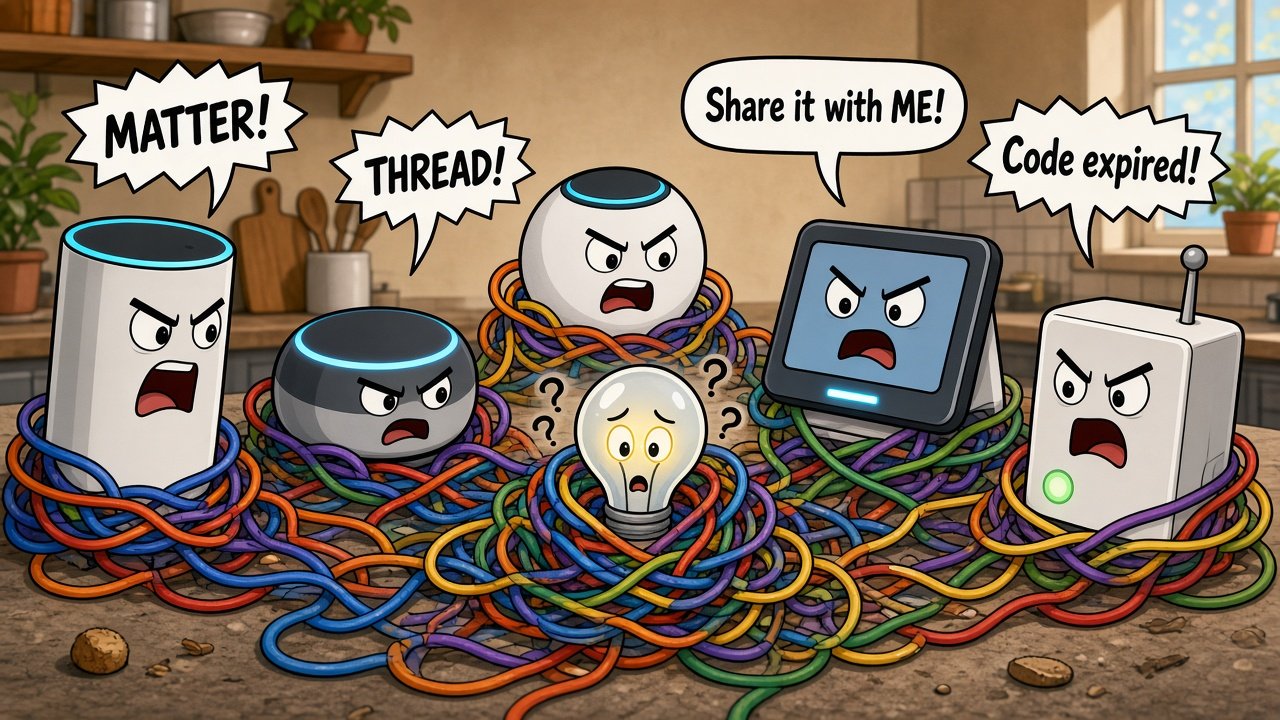
Matter has a feature called multi-admin. In theory it lets one device work with Alexa, Google Home, Apple Home and SmartThings at the same time. In practice, every one of those platforms builds its own separate Matter network, and your device has to be invited into each one.
You can’t just scan the QR code on the box again. That code only works the first time. To add the device somewhere else, you go back to the app where it already lives, dig through its settings for the sharing option (every app calls it something different), generate a temporary code, and type it into the other app before it expires. Then you do it again for the next device. One at a time.
How long do you get? TP-Link’s own instructions say a code from Alexa expires in 15 minutes, a code from Apple Home in 5, and a code from Google Home in 3. Google’s own help page also says you need a separate hub for every platform you want to share with. (Google)
That’s the official process. That’s the good version.
And then there’s Thread
Thread is the low-power mesh network a lot of Matter devices use. Your Apple TV, HomePod, Echo, Nest hub or SmartThings hub can each act as a Thread border router. The catch is that border routers from different companies have mostly set up their own separate Thread networks instead of joining the one you already have.
The fix, a way to share Thread network credentials, was added to the Thread spec in 2024. Samsung added it to some SmartThings hubs in late 2025. In June, the new version showed up in an Apple TV developer beta and in an update for the Google TV Streamer, but when The Verge’s Jennifer Pattison Tuohy tried the Google TV Streamer’s new credential-sharing QR code, it didn’t work for her. At that point, she wrote, everyone was still waiting on Amazon to update its speakers. (The Verge, The Verge)
Her summary of where things stood in late 2025: “three years in and we’re, like, three-quarters of the way there. Sort of. Great job, guys.”
It’s not just me
Tuohy has been saying this for years. Back in 2023 she wrote that multi-admin was “completely broken,” and that devices she shared to a second platform would soon show offline in one of them or disappear altogether. (The Verge) It hasn’t gone away. In March she wrote that “Matter promised it would just work, and it just doesn’t.” (The Verge) In June, after the industry’s own Unify conference, she wrote that sharing devices across ecosystems “can be unreliable,” and that Apple, Google and Amazon were “barely at 1.3” of a spec that had just reached 1.6. (The Verge)
Matter Alpha’s Bertel King spelled out how sharing “quietly fails”: the wrong Wi-Fi network, a Thread device pointed at the wrong Thread network, standing too far away, a VPN left on. And even if you get all of that right, you can still watch it fail. He wrote that sharing a single device can take upwards of five minutes “with no guarantee of success,” and that he’d shared several devices in a row only to have the fourth one fail doing the exact same thing. (Matter Alpha)
The forums are full of it too. One SmartThings user on Reddit said sharing Thread devices from SmartThings to Google Home or Apple Home always failed, but going the other direction, Google Home to SmartThings, worked fine. A factory reset of both hubs didn’t help. (Reddit) An Apple Home user said a plug shared to Alexa connected, then dropped out of setup and never showed up in the Alexa app, even though Apple Home said it was connected to Alexa. The suggested fix was to unplug every Echo except one. (Reddit)
Unplug your other speakers. That’s the workaround. That’s a hack.
The fix exists. Nobody ships it.
Here’s what really gets me. The people who run Matter have already written fixes. Matter 1.4, back in 2024, added “enhanced multi-admin,” which is supposed to share new devices to the other platforms you’ve authorized automatically. This year, Matter 1.6 added “Joint Fabric,” one shared network that every platform can control. Tuohy called it “a feature that should have been there from day one.” (The Verge)
Back in 2024, the group behind Matter said it expected the big platforms to adopt enhanced multi-admin within a year. (The Verge) In April, a maintainer of the open-source matter.js project said that “no ecosystem right now supports this.” (GitHub) In June, Tuohy wrote, “It’s 2026, and we’re still waiting.”
So this isn’t a technology problem anymore. It’s a priorities problem. Apple, Amazon, Google and Samsung all helped build Matter, and none of them is in any hurry to make it easy to use their competitors’ assistants. Tuohy said as much back in 2023: now that Matter is here, the companies are “wholly unmotivated to ensure their platforms work well with their direct competitors.” (The Verge)
What should change
- Ship the fixes that are already written. Enhanced multi-admin and Joint Fabric are in the spec. Put them in the apps.
- Set it up once, see it everywhere. If I add a device to one platform, the other platforms I’ve already approved should just see it. No codes. No timers.
- One Thread network per home. Every border router should join the network that’s already there. Adding a speaker shouldn’t quietly start a second mesh.
- Tell me what broke. “Unable to add accessory” is not an error message. It’s a shrug.
- Same steps, same name, every app. Pick one word for “share this device” and put it in the same place everywhere.
Bottom line
Matter was sold as the end of picking sides. Instead, I still have to pick a side and then beg it to share. The process is overly complicated, and when it does work, it’s a hack at best.
It is simply not acceptable.