





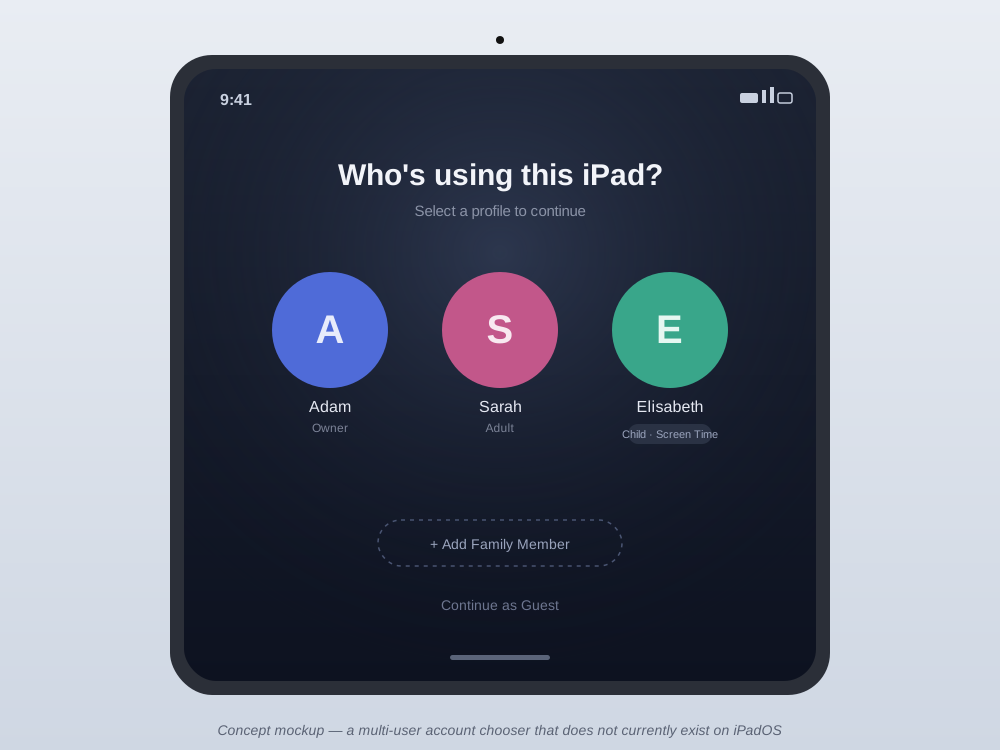

Concept mockup: what a multi-user account chooser on iPadOS could look like. This screen doesn’t exist yet — but maybe it should.
If you’ve ever handed your iPad to your kid, then picked it back up an hour later to find your email drafts abandoned, your Safari tabs replaced with Roblox wikis, and your Netflix “Continue Watching” row full of shows you’ve never heard of — you already know the problem. The iPad, for all its power, still behaves like it belongs to exactly one person.
That’s strange, because the Mac has had proper multi-user login since OS X launched in 2001. Sign out, and the next family member sees their own desktop, their own apps, their own files. Meanwhile the iPad — a device explicitly marketed as a family-room computer, a homework machine, a shared entertainment hub — has never gotten the same treatment.
It raises an obvious question: why can’t iPadOS just show a login screen like the Mac does, so each family member taps their name and gets their own space?
The Case for a Real Account Chooser on iPad
1. Families already share iPads — the OS just doesn’t admit it
A huge share of iPads sold aren’t personal devices. They’re the one tablet that lives on the kitchen counter, gets passed around at bedtime, or sits in the back seat of the car. Apple’s own “Family Sharing” tools exist because Apple already knows this. What’s missing is the piece that would make sharing seamless: separate, switchable profiles, the way Netflix, Mac, and even a shared Windows PC already handle it.
2. Kids deserve their own space — and parents deserve control over it
Right now, giving a child access to a shared iPad usually means one of two imperfect options: hand over the whole unrestricted device, or set up Apple’s “Guided Access” and Screen Time restrictions on top of an adult’s personal account, which mixes the parent’s apps, messages, and purchase history in with the kid’s. A proper account chooser would let each child have their own home screen, their own app layout, and their own Screen Time limits — cleanly separated from mom’s or dad’s actual accounts.
3. Continuity and personalization break down without it
Handwriting suggestions, Safari history, Spotlight search results, autofill passwords, health data, and app recommendations are all built around the assumption of a single user. When three family members share one iPad, all of that gets scrambled together. A dedicated login system would let iCloud, Photos, Messages, and every third-party app actually know who’s holding the device.
4. It already exists — just not on the iPad
This isn’t a hypothetical technical challenge. macOS has full multi-user accounts. Shared Apple TVs already support multiple profiles for Apple TV+ and Fitness+. Even the Apple Watch has “Family Setup” for kids without their own phone. The iPad is the odd one out in Apple’s own lineup.
The Case Against — Why Apple Hasn’t Done This (Yet)
To be fair, there are real reasons this hasn’t shipped, and it’s worth taking them seriously rather than assuming Apple is simply asleep at the wheel.
- iPadOS was built as an iPhone descendant, not a Mac descendant. Its entire security and storage model assumes one Apple ID owns the device. Retrofitting true multi-user support means touching sandboxing, storage partitioning, biometrics, and app licensing all at once — not a small patch.
- App licensing gets complicated. Many iPad apps and in-app purchases are tied to the Apple ID that bought them, not the device. Multiple accounts on one iPad raises real questions about who “owns” a purchased app or subscription in each profile.
- Switching costs storage and speed. Full account separation, done right, likely means separate app data, caches, and possibly separate downloaded apps per user — which could demand more storage and slower switching than people expect from a tablet meant to be picked up instantly.
- It could get watered down into something worse than what we have. Apple already tried a partial version of this with “Shared iPad,” a feature built for schools using Apple School Manager. It technically supports multiple users, but it’s clunky, requires MDM enrollment, and was never designed for a home living room. If a consumer version arrives, it needs to actually be simple — not a shrunk-down enterprise IT feature.
- Privacy and safety complexity. A shared device where kids’ accounts sit next to a parent’s opens up new questions about how iMessage, Face ID, and Screen Time boundaries interact — Apple will want this to be airtight before shipping it broadly.
None of these are excuses to keep ignoring the problem, though. They’re reasons the feature has been hard, not reasons it should stay unbuilt.
Why 2026 Is the Right Moment for This
A few trends make this feel less like a nice-to-have and more like an overdue fix:
- iPads are the default second screen in most households now. They’ve fully replaced the family desktop computer in a lot of homes, which means they need to behave like a shared computer, not a personal phone.
- Apple Intelligence and on-device AI make personalization even more important — and even more awkward without separate accounts. An AI assistant that learns from your calendar, messages, and habits is far less useful, and arguably a privacy risk, if it’s learning from three different family members’ data smashed into one profile.
- Screen Time and child safety expectations have only gotten stricter. Regulators and parents alike are pushing for cleaner separation between kids’ and adults’ digital spaces, and a shared-but-undivided iPad works against that goal.
- The technical excuses are weaker than they used to be. Storage is cheap, iPads are fast, and Apple has already solved harder versions of this problem on the Mac and Apple TV. There’s no longer a strong technical reason iPadOS couldn’t support real multi-user switching, even if it means a leaner version than macOS gets.
The Bottom Line
A tap-to-switch account chooser — genuinely simple, no MDM enrollment, no school IT department required — should be considered a must-have iPadOS feature going into 2026 and beyond. It doesn’t need to be complicated: a screen very much like the one mocked up above, where each family member taps their name, sees their own home screen, and gets their own Screen Time rules, iCloud data, and app library.
The Mac figured this out over two decades ago. The Apple TV figured it out for streaming. It’s past time the iPad — the device most likely to be sitting on a kitchen counter shared by an entire family — caught up.
Do you think Apple should add proper multi-user support to iPadOS? Let us know in the comments below.